TL;DR :
Guyana is South America’s under-the-radar, English-speaking gem, offering rainforest, savannah, and coastline without the crowds. Top highlights : Kaieteur Falls (a massive single-drop waterfall reached by charter flight), Georgetown (Stabroek Market, St. George’s Cathedral, the seawall), the Iwokrama Rainforest canopy walkway, the Rupununi savannah (giant anteaters, caiman, cattle-ranch stays, jaguar potential), remote Shell Beach (sea turtle nesting), the Essequibo River and Bartica (mining-town river trips), and Mount Roraima on the tri-border plateau. Best visited outside the rainy seasons (Aug–Sept or Feb–Mar), and best explored via a local tour operator since roads and river crossings in the interior are unreliable. It’s a trip for travelers who want an unpolished, genuinely undiscovered destination rather than resorts and easy checklists.
Guyana sits in a strange spot on the map of South America. It shares a continent with Brazil, Venezuela, and the Guianas, but it doesn’t share the reputation. Most travelers can’t point to it on a map, let alone tell you what there is to do there. That is precisely what makes going there worthwhile. While its neighbors deal with overtourism at their biggest sites, Guyana still feels like a country you’re discovering rather than checking off a list.
It’s also the only English-speaking country in South America, a legacy of British colonial rule, which makes it an easier entry point for first-time visitors to the continent than most people realize. Between the rainforest interior, the Rupununi savannah, and a low-key capital city on the Atlantic coast, there’s more range packed into this country than its size suggests. Here’s a real look at what to do there, based on what actually stands out rather than a generic checklist.
Kaieteur Falls
Almost every conversation about Guyana starts here, and for good reason. Kaieteur Falls is a single-drop waterfall in the middle of Kaieteur National Park, and it drops roughly five times the height of Niagara Falls. What sets it apart isn’t just the height, though it’s the setting. There are no gift shops, no crowds, no guardrails packed with tourists taking the same photo. You fly in on a small plane, walk through the forest for a short stretch, and then the trees just open up onto this enormous drop with mist rising off the bottom.
The falls were first documented by a British surveyor in the 1870s, but the site itself has clearly existed a lot longer, carved into the sandstone plateau over thousands of years. Most visitors do this as a day trip by charter flight from Georgetown, since there’s no road access. It’s not a cheap excursion, but it’s the one thing in Guyana that consistently gets described as unforgettable rather than just nice.
Georgetown, the Capital
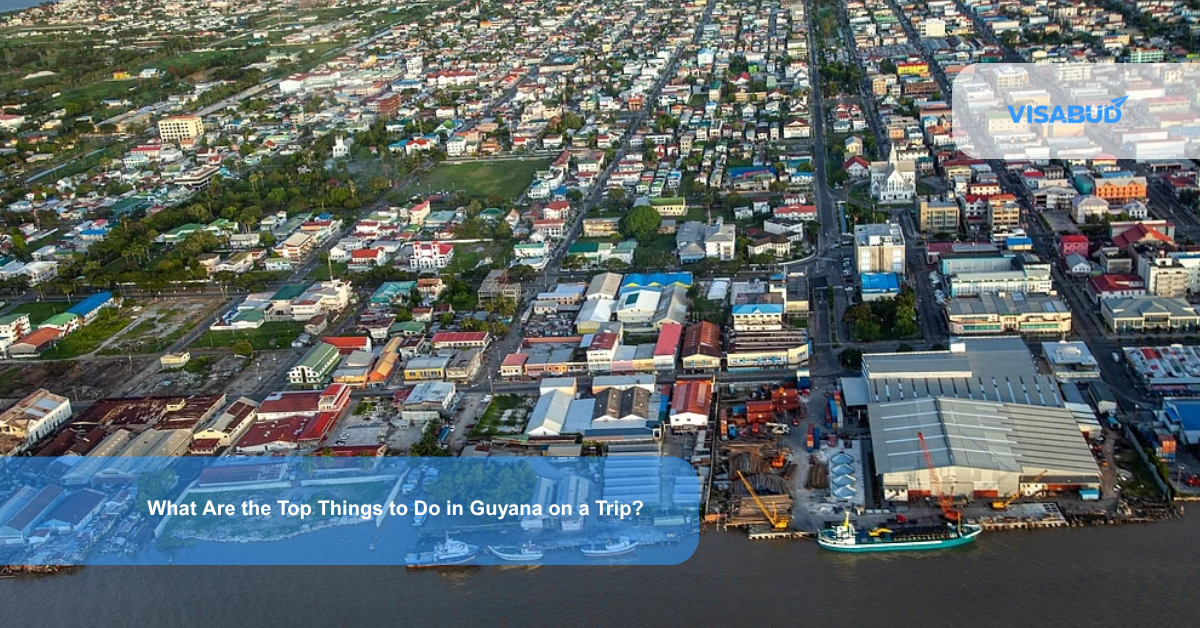
Georgetown won’t win any awards for polish. The roads have potholes, some of the colonial-era wooden buildings are falling apart, and the city has a rougher edge than a typical Caribbean capital. But that rawness is part of its appeal, and there’s genuinely more to see here than people expect.
Stabroek Market is the obvious starting point, a cast-iron market building from the late 1800s that still functions as the commercial heart of the city, selling everything from fresh produce to gold jewelry. From there, it’s worth walking to St. George’s Cathedral, one of the tallest wooden buildings in the world, built in a neo-Gothic style that looks almost out of place against the tropical backdrop. The Botanical Gardens are a quieter stop, known for their birdlife rather than manicured lawns, and the Guyana National Museum gives a decent overview of the country’s colonial and political history if you want context before heading into the interior.
The seawall along the Atlantic coast is where locals actually spend their evenings, especially on weekends, and it’s a good way to get a feel for the city without doing anything touristy at all.
Iwokrama Rainforest and the Canopy Walkway
Guyana’s interior is almost entirely rainforest, and the Iwokrama Forest is where most visitors go to experience it properly. It’s a protected reserve set up specifically to study how a rainforest can be used sustainably, which means the wildlife here hasn’t been pushed out by logging or agriculture the way it has in parts of the Amazon basin.
The main draw is the canopy walkway, a series of suspension bridges strung up around 30 meters above the forest floor. Walking across it puts you at eye level with the upper canopy, which is where a lot of the forest’s bird and primate activity actually happens. It’s a genuinely different way to experience a rainforest compared to walking through it at ground level, and it’s one of the few places in South America where this kind of structure exists at this scale.
Guided night walks and river trips from the lodges near Iwokrama are also worth building into an itinerary, since a lot of the wildlife here, including several cat species, is nocturnal.
Rupununi Savannah
If Iwokrama is the rainforest side of Guyana, the Rupununi is the opposite. This is open savannah in the southwest of the country, closer in feel to the plains of East Africa than to the jungle most people picture when they think of South America. Giant anteaters wander across the grasslands, black caiman patrol the rivers, and it’s one of the more reliable places on the continent to spot a jaguar, though sightings still aren’t guaranteed.
A lot of the tourism infrastructure out here is built around working cattle ranches, some of which have been converted into guesthouses. Staying on one gives a very different experience than a standard eco-lodge where you’re sharing space with vaqueros, eating what the ranch produces, and often joining low-key horseback trips out onto the plains. The Rupununi River itself is worth a boat trip too, both for the giant river otters and for the sheer scale of Victoria amazonica lily pads that float on some of its quieter stretches, some of which grow wide enough to hold a small child.
Shell Beach
For something completely different, Shell Beach runs along roughly 90 miles of the Atlantic coast in the country’s northwest. It’s remote enough that getting there usually requires a boat trip along the coast, and there’s very little in the way of infrastructure once you arrive. That remoteness is exactly what makes it valuable: it’s one of the most important nesting sites in the region for sea turtles, with four different species coming ashore here depending on the season.
This isn’t a beach for sunbathing or resorts. It’s a conservation-driven destination, and most trips here are organized around turtle-watching programs run by local conservation groups. If wildlife travel matters more to you than beach lounging, it’s worth the extra effort to get out here.
The Essequibo River and Bartica
The Essequibo is the largest river in Guyana, cutting through forest and savannah on its way to the Atlantic. Bartica, a small mining town sitting where the Essequibo meets the Mazaruni and Cuyuni rivers, is the usual jumping-off point for river trips and gold-mining country further inland. It’s not a polished tourist town, but it gives a much more honest look at how a large part of Guyana’s economy actually works, since gold and diamond mining still drive much of the interior.
River trips from Bartica can take you past small islands, rapids, and old mining settlements, and it’s a reasonable stop if you’re heading toward the Kaieteur or Iwokrama regions overland rather than by charter flight.
Mount Roraima
Mount Roraima sits right on the border where Guyana, Venezuela, and Brazil meet, and while most climbing routes to the summit go through Venezuela, the Guyanese side offers striking views of the same flat-topped plateau. At over 2,800 meters, the mountain’s summit is often wrapped in cloud, and its sheer cliffs are believed to have inspired parts of Arthur Conan Doyle’s “The Lost World.” Even without summiting it, seeing Roraima rise out of the surrounding savannah is one of the more striking landscapes in this part of South America.
When to Go
Guyana has two rainy seasons, roughly mid-April to the end of July and mid-November through January. Outside of those windows particularly late August into September, or February and March the country is greener, drier, and easier to move around in, since a lot of the roads and river routes become unreliable during heavy rains. Most attractions, including Kaieteur, stay accessible year-round, but travel logistics get noticeably easier outside the rainy stretches.
Getting Around
This is the part of planning a Guyana trip that catches people off guard. Roads outside Georgetown are inconsistent, river crossings can involve waiting for a ferry, and a lot of interior travel depends on small aircraft rather than cars. Because of this, most visitors book multi-day trips through a local tour operator rather than trying to piece together an independent itinerary. It’s not the cheapest way to travel, but given how spread out the country’s highlights are, it’s usually the most realistic one.
Final Thoughts
Guyana isn’t a place you visit for polished resorts or an easy checklist of sights. It rewards a bit of effort: a flight to a remote waterfall, a boat ride to a mining town, a few nights on a cattle ranch in the middle of nowhere. What you get in return is a version of South America that still feels unshaped by mass tourism, with rainforest, savannah, and coastline that most travelers have never even considered. For anyone looking for a destination that still feels genuinely undiscovered, it’s hard to find a better fit on the continent right now.
Planning a Guyana trip? Contact Us for travel guidance.